
By Sherwin Prior, CEO/Co-Founder, Juise Mobility
At Harvey Mudd College in January 2026, an e-skateboard battery ignited on the second floor of a three-story residence hall, damaging multiple rooms. Two months later, at San Diego State, an e-scooter caught fire on the fourth floor of an eight-story dorm just before 11 p.m. — three students were evaluated for injuries, one with a mild burn, and sixteen rooms were damaged before the building’s sprinklers put it out. That same March, a lithium-ion battery fire tore through a room at Yale’s School of Engineering & Applied Science.
Three incidents, three campuses, all within about two months of each other. None of them are outliers. They’re a preview of what every property manager is now managing around.
The math property managers are running.
Private e-bike and e-scooter ownership has grown far faster than the infrastructure built to support it. Residents want to charge indoors because it’s the only option most buildings give them — in an apartment, a dorm room, an office break room. Lithium-ion batteries that fail while charging unattended, overnight, in an occupied building are what turn a single bad cell into a multi-unit evacuation.
For a property manager, that risk shows up in very concrete terms:
Resident demand. E-bikes and e-scooters aren’t a niche anymore; they’re daily transportation. Buildings that don’t offer somewhere safe to charge are asking residents to break the rules just to get to class or work.
Liability and insurance exposure. A battery fire isn’t a maintenance issue — it’s a life-safety incident with real injury and displacement risk, and insurers are increasingly asking what buildings are doing about it.
Remediation cost. Sixteen damaged rooms, a temporarily closed academic building, smoke and water damage that spreads well beyond the unit of origin — the cost of one incident routinely dwarfs the cost of preventing it.
Fire code and compliance pressure. Cities and campuses are moving toward rules that restrict or prohibit indoor charging of micromobility devices, which leaves property managers needing a compliant alternative to offer residents — not just a ban.
The risk doesn’t stop when the plug comes out.
It’s tempting to treat this as purely a charging problem — get the plug out of the bedroom and the risk goes with it. The data says otherwise. The Massachusetts Department of Fire Services, tracking lithium-ion device fires from October 2023 through September 2025, found that 52% occurred when the device was not actively charging. The Center for Campus Fire Safety, which has logged li-ion incidents on college campuses since December 2023, found an even higher share: 63% of devices involved in a fire were not charging at the time. FDNY’s own Bureau of Fire Investigation data, reported by NFPA Journal, shows the same pattern getting worse, not better: in 2023, 50% of device fires involved a device that was not charging at ignition, versus 34% actively charging; by 2024, that gap had widened to 53% not charging versus just 26% actively charging.
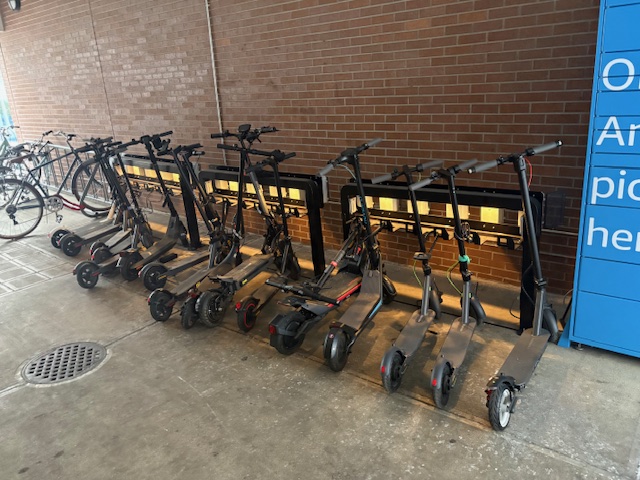
That’s not an argument against outdoor charging — it’s the stronger argument for it. If a damaged or defective cell can fail hours after it’s unplugged, the safest place for that battery to sit, charging or idle, is somewhere other than a bedroom, a hallway, or a stairwell. An outdoor station isn’t just where a device gets plugged in; it’s where it lives while it’s not being ridden. That takes the risk out of the building entirely, instead of just relocating the moment residents happen to plug in.
Getting the device — and its battery — out of the building altogether, not just off the charger.
The proactive ones aren’t waiting for an incident.
Not every property manager is reacting to a fire that already happened on their property. A growing number are getting ahead of it — reading the same headlines everyone else is, then treating outdoor charging as a preventable-risk item rather than something to revisit after an insurer, a fire marshal, or a resident forces the issue. That’s a different posture than compliance. It shows up as charging infrastructure going into a new development’s site plan from day one, or a campus housing office adding stations during a routine capital project instead of after a dorm evacuation.
That proactive posture matters most where ridership never really has an off-season. Juise Mobility’s customers are concentrated across Alabama, Georgia, South Carolina, North Carolina, Tennessee, and Texas — a footprint where the climate supports year-round riding. E-bikes and e-scooters don’t get parked for the winter there, which means the charging habit, and the risk that comes with it, doesn’t let up either. Property managers in that region don’t get a seasonal lull to plan around; the ones moving early are the ones who’ve noticed that.
Why outdoor charging is the answer, not just a mitigation.

Fire in a residence hall, despite policy ban.
Banning indoor charging without providing an alternative doesn’t remove the risk — it just moves it somewhere less visible, into hallways, stairwells, and dorm rooms where a fire is hardest to contain and slowest to notice. The property managers moving fastest on this are the ones who’ve recognized that the fix isn’t stricter rules; it’s giving residents a place to charge that’s actually safer and just as convenient.
That’s the case for outdoor charging: batteries charge away from sleeping residents and combustible interiors, incidents are contained in open air rather than a stairwell, and the alternative is built into daily routine instead of competing with it. Done well, it turns a liability line item into a visible amenity — something a leasing office or a campus housing office can point to, not just a policy they have to enforce.
How Juise Mobility helps.
At Juise Mobility, we build outdoor charging infrastructure for micromobility — e-bikes, e-scooters, and other personal electric devices — for multi-family communities, university campuses, and private fleets. Our Juise Bar and Juise Pack charging stations, paired with device-registration and compliance software, are giving property managers across the Southeast and Texas a safe, code-ready alternative to indoor charging, and giving residents somewhere to plug in without smuggling a battery past a fire marshal.
Every property manager we talk to is running the same math: the cost of a station versus the cost of a fire. Increasingly, that math only points one way – up!
The bottom line for multi-family, campus, and commercial property owners.
Residents, students, employees, and delivery riders are going to keep using e-bikes and e-scooters, because they’re cheaper and faster than a car for a huge share of daily trips. The real decision in front of property owners isn’t whether that use happens, or even when a battery might fail. It’s whether the battery, charging or not, spends its life twenty feet from someone’s bed or twenty feet from the building. The central message is the same whether the property is an apartment complex, a residence hall, or a corporate campus: indoor storage of these batteries, charging or not, is the risk. Moving both charging and everyday storage outdoors is the single change that turns a battery failure, at any hour, into a maintenance issue instead of a life-safety event.
Sources
[1] Center for Campus Fire Safety, Li-Ion Fire Reporting Program
[2] Massachusetts Department of Fire Services
[3] NFPA Journal, “Lithium-Ion Battery Fires” (FDNY research), Aug. 2025